


 Menu
MenuSurgical Removal of Impacted Teeth
Impacted Canines
Introduction
The primary teeth, also called baby teeth, erupt between the ages of 8 to 30 months and shed between the ages of 6 to 12 years. The secondary teeth, also called permanent teeth or adult teeth erupt from the age of 6 to 25 years. Impaction can occur during the growth of the secondary teeth when one or more teeth ceases to erupt and remains underneath the gum line, either partially or completely. This is commonly seen in canine teeth (long, pointy teeth in the upper and lower jaw). When canines fail to erupt completely through the gums it is referred to as an impacted canine.
Causes
The common causes of canine impaction are:
- Inheritance
- Mismatched size and shape of teeth
- Problems in the number and alignment of teeth
- Early loss or removal of baby teeth
Complications
Canine impaction can cause a sufficient gap in the teeth affecting their function and appearance. Some impacted teeth may push into the adjacent teeth and damage them. Rarely, a cyst can develop around the crown of the impacted canine and push and displace the adjacent teeth.
Diagnosis
The impaction of canines can be detected at an early age of 8-9 years. The doctor will diagnose canine impaction through inspection and palpation (examiner feels the size and shape of the teeth by touch). In order to confirm the diagnosis, the doctor will order X-rays. This evaluates the position of the impacted canine and condition of the gums. X-rays provides clear evidence to determine the best treatment option.
Treatment
An impacted canine that doesn’t cause any problems does not need any treatment. The treatment option depends on the type and severity of the alignment of canines. Your doctor may prescribe pain killers to relieve pain and discomfort. You may also be advised to rinse your mouth with warm salt water to soothe your gums. There are various surgical procedures for the treatment of impacted canines.
- Exposure: The surgery is performed under general anaesthesia and comprises of a small cut in the palate to expose the crown of the tooth. Based on the requirement of space for the canine to grow, the adjacent teeth may be extracted and an orthodontic bracket (a device which helps to align teeth in a proper position), might be introduced. Exposing and aligning the impacted canines will prevent future impairments and make the smile aesthetically pleasing.
- Removal: If the canine is buried in a position that is difficult for realigning and is causing problems to the adjacent teeth, your doctor will recommend the removal of the tooth. This is performed under local or general anaesthesia. If there is a noticeable gap, a denture or bridge may be used.
- Transplantation: This procedure is generally preferred if surgical exposure of the teeth is not a suitable option for treatment and if there is sufficient space between the teeth. Your surgeon will remove the baby canine and the impacted permanent canine. The impacted tooth is then carefully placed in the right position. The transplanted tooth will be braced for 2-3 weeks to set it correctly.
Post-operative care
After surgery, you may feel pain, bleeding and discomfort at the surgical site, for which your doctor will prescribe medications. Swelling can be reduced by applying ice packs. You will be advised to follow a soft and bland diet, until you are comfortable chewing.
Impacted Wisdom Teeth
Introduction
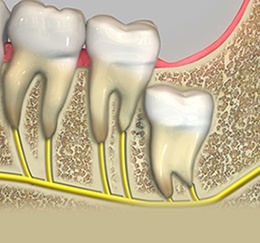
Tooth eruption is nothing but the process in which the tooth travels from beneath the jaws to enter the mouth and become visible to us. A tooth is called “impacted” if its path is obstructed by any other tooth, bone or soft tissue.
Normal Sequence of Tooth Eruption
The permanent teeth which are the second set of teeth start appearing at the age of 6 and by 13 years, all the baby teeth are replaced. Within these 7 years, the 20 baby teeth are replaced by 28 permanent teeth.
In addition to these, four third molars (wisdom teeth) two in each jaw (upper and lower) appear by the age of 21, making 32 permanent teeth in adults.
The jawbone should grow normally to provide space for the extra teeth, but if it does not grow, there are chances that the third molar teeth could get impacted in the jaw.
Types of Impaction
Depending upon the position of the impacted tooth inside the jawbone, there are four types of impaction:
- Mesial Impaction
- Vertical Impaction
- Horizontal Impaction
- Distal Impaction
“Mesial” means that the wisdom tooth is angled forward, toward the front of the mouth.
It can also be classified as:
- Bony impaction
- Soft-tissue impaction
Bony impaction: wisdom tooth is still fully embedded in the jawbone.
Soft-tissue Impaction: the upper portion of a wisdom tooth has come out of the bone, but is still covered by a layer of gum.
Symptoms of Impaction
- Gum swelling in the back of your mouth
- Difficulty /pain in opening your jaw
- Bad breath
- Bad taste in the mouth
- Pain while chewing or biting
Causes of Impaction
Lack of Space: During the process of evolution, the jaws have become smaller and smaller in size, because the use of jaws for chewing has declined as we eat more soft food. An underdeveloped jaw will not be able to accommodate all 32 teeth.
Heredity: This is another important factor. Children of parents who have had impacted third molars are more likely to have their third molars impacted.
Certain diseases: Rickets, Endocrine diseases, anemia, achondroplasia, cleidocranial dysostosis, Treacher Collins syndrome are some diseases associated with impacted teeth.
Problems Caused By Wisdom Teeth
Pain and swelling
Partially erupted third molars are difficult to clean and the food particles can get stuck there which causes gum irritation and pain.
In cases when the lower third molar has not erupted through the gums, the upper tooth bites down on the gum covering the tooth and causes pain.
Decay
It is difficult to keep these areas of the mouth clean. Most of the time the toothbrush does not reach there.
Crowding
An erupting wisdom tooth can exert force on adjacent teeth causing them to move in a crooked way.
Cyst
If the wisdom tooth is left inside the bone, the developmental sac surrounding it can be filled with fluid forming a cyst. It can destroy the bone.
Diagnosis
X-rays of the wisdom teeth are made to assess the positions, shapes and sizes of the tooth, the covering bone and the nerve.
X-rays also locate cysts or tumors that may be associated with the tooth and to assist the surgeon to plan the surgical procedure.
Treatment Options
- In cases where there is sufficient space for the teeth to erupt such as with soft-tissue impaction, then a Pericoronal flap excision is done.
- The second option is surgical removal of impacted third molars between ages 16-20 if it is found that there is no space for them to erupt.
Pericoronal Flap Excision
If the soft tissue overlying the wisdom tooth is infected, a condition called pericoronitis, then this can be removed by various methods:
- ‘cold steel’,
- glacial acetic acid,
- radio-surgical means,
- LASER or
- Electrocautery
Surgical Removal
- Antibiotics and anti-inflammatory drugs are given to eliminate infection in the area.
- It is a minor surgical procedure lasting 20-45 minutes.
- The procedure is done under local anesthesia.
- An incision is made to open up the flap.
- The bone covering the tooth is cut to expose the tooth crown.
- The tooth is removed either in whole or by cutting it into pieces and removing the pieces out.
- Surgical wound is sutured.
- Removal of the stitch after a week.
Complications /risks associated with surgical removal:
- Pain: There could be some pain felt around 3 hours after the procedure when anesthetic effect reduces. Pain medications will be prescribed to keep you comfortable at home.
- Infection: Antibiotics should be taken as prescribed to prevent infections from developing.
- Swelling: Swelling gradually comes down after the course of antibiotics is taken.
- Bleeding: Some post-surgical bleeding is common and is easily controlled with the pressure of biting on gauze.
Post-operative Instructions
- Use ice pack covered in a towel and place it on operated area from the outside (on the cheek) to reduce swelling.
- Bite down onto a clean gauze piece with pressure to stop bleeding.
- Eat soft food and drink lots of liquids.
- Brush your teeth gently in the area during the first few days after the surgery.
- Take prescribed medications and follow all instructions from your surgeon.
 Cosmetic
 Dental Implant &
 Cosmetic &
 Oral &